
Comparing Linkin Park’s Vocalists: Chester Bennington and Emily
Comparing Linkin Park’s Vocalists: Chester Bennington and Emily | Linkin Park’s vocal identity has always been one of the band’s greatest strengths. From the explosive combination of Chester Bennington’s emotional singing and Mike Shinoda’s rap delivery to the band’s modern era with Emily Armstrong, the group has continued to evolve while maintaining its distinctive blend of rock, hip-hop, electronics, and alternative influences.
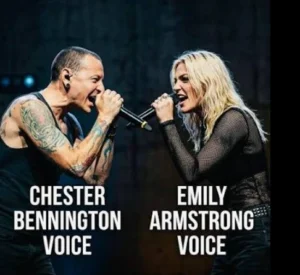
Comparing Linkin Park’s vocalists is not simply a question of deciding who is “better.” Each vocalist brings a different character, technique, and emotional quality to the band’s music. Chester Bennington established the sound that made Linkin Park globally famous, while Emily Armstrong has helped the band enter a new creative chapter.
Chester Bennington: The Voice That Defined an Era
Chester Bennington joined Linkin Park in the late 1990s and became the band’s primary lead vocalist during its breakthrough years. His voice combined melodic singing, powerful screams, vulnerability, and intense emotional expression.
When Hybrid Theory arrived in 2000, Bennington’s vocals immediately became a defining part of the band’s sound. Songs such as “Crawling,” “One Step Closer,” and “In the End” demonstrated how effectively he could move between restrained melodies and explosive vocal performances.
The official Linkin Park biography describes the original lineup as a combination of Bennington’s vocals and Shinoda’s creative contributions, with Hybrid Theory eventually becoming one of the most successful debut albums of the 21st century.
What Made Chester’s Voice Unique?
Chester’s greatest strength was his ability to communicate extreme emotion.
His clean vocals could sound vulnerable and intimate, while his screams could become aggressive and almost explosive. That contrast gave Linkin Park’s songs a dramatic quality.
His vocal style worked particularly well with the band’s lyrical themes. Songs dealing with frustration, insecurity, anger, isolation, and emotional pain benefited from his ability to make the lyrics feel intensely personal.
Rather than treating screaming as simply a heavy-metal technique, Chester used it as another form of emotional expression.
Chester’s Vocal Range and Control
One reason Chester became so influential among rock singers was his ability to move between different vocal registers and textures.
He could deliver:
- Powerful high notes
- Emotional clean vocals
- Gritty melodic passages
- Aggressive screams
- Controlled vocal distortion
- Quiet, vulnerable performances
This versatility allowed Linkin Park to move between genres without losing its identity.
His performance on songs such as “Given Up” became particularly famous for its demanding vocal sections, while tracks such as “Leave Out All the Rest” demonstrated a much softer side of his voice.
Mike Shinoda’s Role as a Vocalist
Although Chester was usually viewed as Linkin Park’s frontman, Mike Shinoda was also essential to the band’s vocal identity.
Shinoda brought a completely different approach through rap, spoken delivery, melodic vocals, and songwriting. His rhythmically precise verses created a contrast with Chester’s powerful singing.
That contrast became one of Linkin Park’s trademarks.
A typical song could move from Shinoda’s controlled rap verse into Chester’s emotional chorus, creating a dramatic change in energy.
Apple Music describes Linkin Park’s early sound as a combination of aggressive rock, hip-hop, and emotional vocals from Bennington and Shinoda.
Why the Chester and Mike Combination Worked
The chemistry between Chester and Mike was more important than either vocalist’s individual technique.
Shinoda’s delivery was generally more rhythmic and restrained. Chester could then enter with a huge melodic or screamed section.
This created a musical conversation between two very different vocal personalities.
For example, the band’s early material frequently used:
Mike Shinoda: rhythmic verses and rap
Chester Bennington: melodic choruses and emotional intensity
Both: layered vocals and harmonies
That structure became one of the most recognizable elements of Linkin Park’s sound.
Emily Armstrong: A New Chapter
After Chester Bennington’s death in 2017, Linkin Park entered a period of uncertainty. The band eventually returned in 2024 with Emily Armstrong as a new co-lead vocalist alongside Mike Shinoda.
Armstrong previously performed with the rock band Dead Sara. Linkin Park’s official biography says that the band’s renewed creative process eventually developed into recording sessions with Armstrong and drummer Colin Brittain, leading to the album From Zero.
Her arrival represented more than simply finding someone to sing Chester’s parts.
It marked a new era for the band.
How Emily Armstrong’s Voice Differs From Chester’s
Emily Armstrong has a powerful rock voice, but she does not sound exactly like Chester—and that is important.
Her delivery can be aggressive, gritty, and emotional, but her tone and phrasing have their own identity.
During Linkin Park’s first major performance with Armstrong in September 2024, the Los Angeles Times noted that she approached classic songs such as “Crawling” and “Given Up” with confidence while reshaping the material around her own voice.
This difference allows the band to perform its classic catalog without presenting Armstrong as a simple replacement or imitation.
Armstrong’s Strengths
Armstrong brings several qualities that fit Linkin Park’s musical style.
Powerful Rock Delivery
Her voice can move from melodic passages to intense rock vocals, giving her the flexibility required by the band’s older material.
Grit and Energy
Her delivery has a raw quality that works particularly well with heavier Linkin Park songs.
Distinct Identity
Rather than attempting to reproduce Chester’s voice exactly, Armstrong brings her own tone and interpretation.
Vocal Chemistry With Mike Shinoda
The combination of Armstrong’s rock vocals and Shinoda’s rap and melodic delivery creates a new version of the vocal contrast that helped define Linkin Park’s original sound.
The Associated Press similarly noted that Armstrong pays respect to the band’s established style without simply imitating Bennington.
Chester vs. Emily: A Vocal Comparison
| Vocal Quality | Chester Bennington | Emily Armstrong |
|---|---|---|
| Vocal identity | Highly distinctive | Distinctive in her own way |
| Clean singing | Emotional and melodic | Strong and expressive |
| Aggressive vocals | Extremely intense | Gritty and powerful |
| Emotional delivery | Vulnerable and dramatic | Raw and energetic |
| Vocal role | Defined the original era | Represents the new era |
| Relationship with Mike | Established classic chemistry | Creates a new dynamic |
| Approach to old songs | Original recordings | New interpretations |
| Overall character | Emotional intensity | Raw rock energy |
The comparison shows why it is difficult to declare one vocalist simply “better.” They serve different moments in Linkin Park’s history.
What About Mark Wakefield?
Before Chester Bennington, Linkin Park’s early history included Mark Wakefield as the band’s vocalist during its Xero era.
Wakefield was part of the group’s formative period before the lineup and musical direction evolved. His role is important historically because it represents the band’s development before Hybrid Theory established the identity most listeners know today.
However, Chester’s arrival dramatically changed the band’s vocal possibilities and helped shape the sound that would eventually reach a worldwide audience.
The Importance of Mike Shinoda Beyond Rap
When discussing Linkin Park’s vocalists, it is easy to focus only on the singers who occupy the center of the stage.
Shinoda deserves special attention because his contribution goes beyond rapping.
He has been deeply involved in Linkin Park’s songwriting and production. His official website lists numerous Linkin Park writing and production credits, including “The Emptiness Machine,” “Lost,” and “Good Things Go.”
His voice therefore functions as part of a broader creative system.
The contrast between Shinoda and the band’s lead singers is one of the reasons Linkin Park can sound instantly recognizable even when its vocal lineup changes.
How From Zero Changes the Comparison
The 2024 album From Zero provides the clearest opportunity to hear the band’s new vocal direction.
Released on November 15, 2024, it became Linkin Park’s first studio album following the death of Bennington and introduced Armstrong as part of the band’s new lineup. The official discography lists From Zero as the group’s eighth studio album.
Songs such as “The Emptiness Machine” demonstrate how Armstrong and Shinoda can work together without simply recreating the exact vocal formula of the early albums.
The result is familiar, but not identical.
That distinction is important.
Should Emily Armstrong Be Compared Directly With Chester?
Fans naturally compare the two vocalists because Armstrong performs songs that Chester originally recorded.
However, a more useful comparison is to examine what each vocalist contributes.
Chester represents the emotional foundation of Linkin Park’s classic era.
Emily represents the band’s willingness to continue creating music while acknowledging its history.
Trying to determine whether Armstrong can “replace” Chester misses the bigger picture. Chester’s contribution cannot be reproduced because his voice, personality, and history with the band were unique.
Armstrong’s role is different: she is helping create a new version of Linkin Park.
Why Chester Bennington Remains Irreplaceable
Chester’s impact on Linkin Park cannot be separated from the band’s most important years.
He recorded seven studio albums with the original lineup, from Hybrid Theory through One More Light, and his voice became closely associated with an entire generation of alternative rock and nu-metal listeners. Linkin Park’s official history notes that the band released seven major albums during that first era before the loss of Bennington in 2017.
His performances continue to define songs that millions of fans know by heart.
For that reason, any new vocalist performing the band’s classic material faces an impossible comparison.
The strongest approach is not to recreate Chester perfectly, but to respect the original performances while allowing a new vocalist to bring something personal to them.
Linkin Park’s Vocal Evolution
Looking at the band’s history reveals a broader pattern.
Mark Wakefield represents the early formative period.
Chester Bennington became the defining lead vocalist of Linkin Park’s classic era.
Mike Shinoda remained a central co-vocalist and creative force throughout the band’s history.
Emily Armstrong represents the band’s current chapter, bringing a different vocal identity to both classic songs and new material.
This evolution demonstrates that Linkin Park has never depended on one vocal technique alone.
Its identity comes from the interaction between voices, production, instrumentation, lyrics, and experimentation.
Comparing Linkin Park’s vocalists is ultimately less about choosing a winner and more about understanding how each voice shaped the band’s evolution.
Chester Bennington had a rare ability to combine vulnerability with explosive power, making his vocals a defining element of Linkin Park’s classic sound.
Mike Shinoda provided the rhythmic and melodic counterbalance that helped make the band’s music distinctive.
Emily Armstrong brings a different energy to the group. Her powerful rock delivery gives the band a way to perform its classic material while also moving forward with new music.
Chester’s legacy remains irreplaceable, but Linkin Park’s current era does not have to erase that legacy. With From Zero, the band has chosen a different path: remembering where it came from while creating something new.
That may be the most interesting part of comparing Linkin Park’s vocalists. The voices have changed, but the band’s willingness to evolve remains.